Devagar com o andor que o santo é de barro
Exhibition views
Works

Details
Exhibition text
Easy Does It….
by Matheus Drumond
Of what actually happened, there is often little left. From this, over time, many stories and all sorts of rumors spring up—conversations that meander aimlessly, skirting any control over what is established as official. And in a place with an exaggerated past, such as Ouro Preto, listening to what’s being said exposes the visitor to a prodigious imagination. It’s best to take it easy.
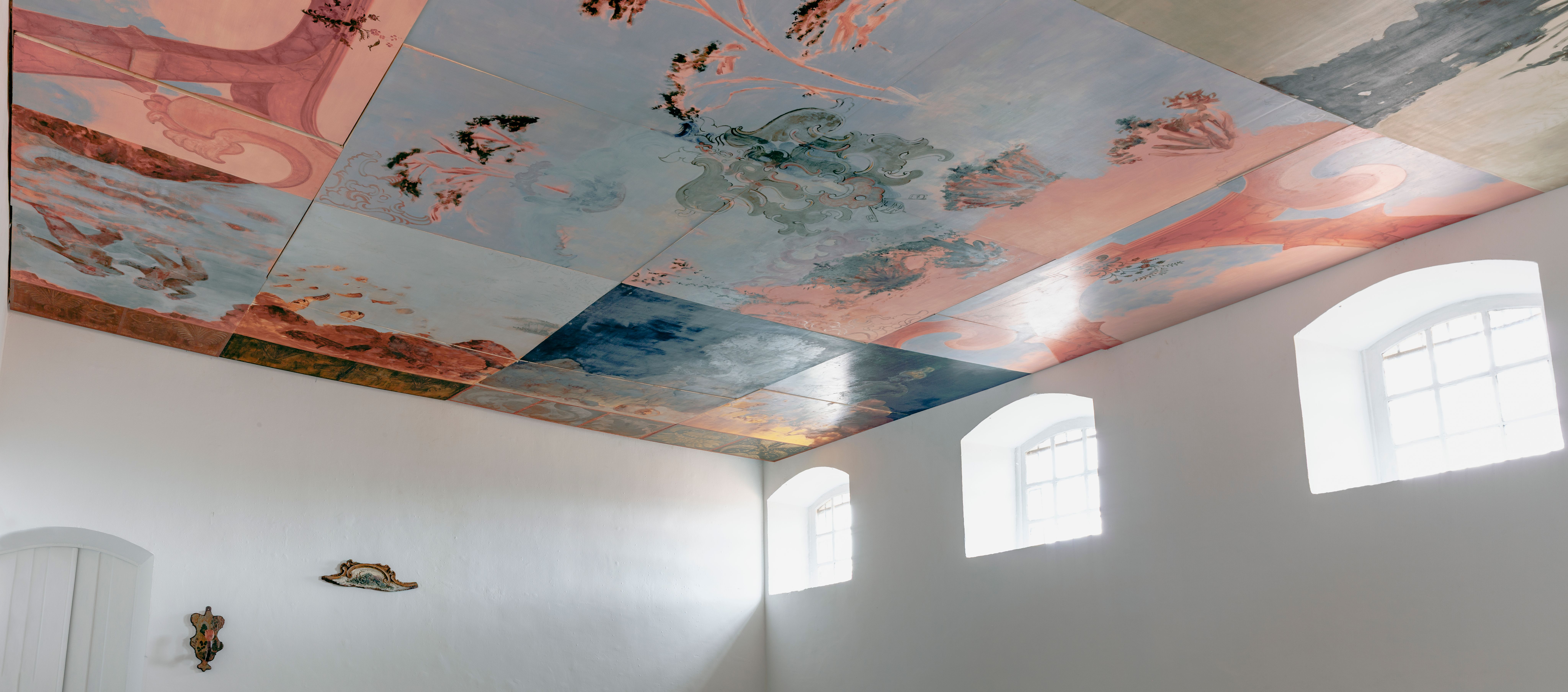
The painter who is now presenting his work did not emerge unscathed from the journey. He came to Ouro Preto in search of the painting of the past (or the timeless in painting, as in Guignard’s work), and returned full of stories to tell. Full of stories and full of painting. Mestre Ataíde’s painting captivated him; but it was the vernacular painting that held him fast—the kind that, on ceilings, pediments, gables, and pillars, conjured up faux silks and marbles, rocaille ornament, and anonymous little roses. What was left for the poor colonial man, from whom gold slipped through his fingers, but to emulate? To emulate the costly and unattainable materials, to create here with his eye there, fixed on what he could see only indirectly.
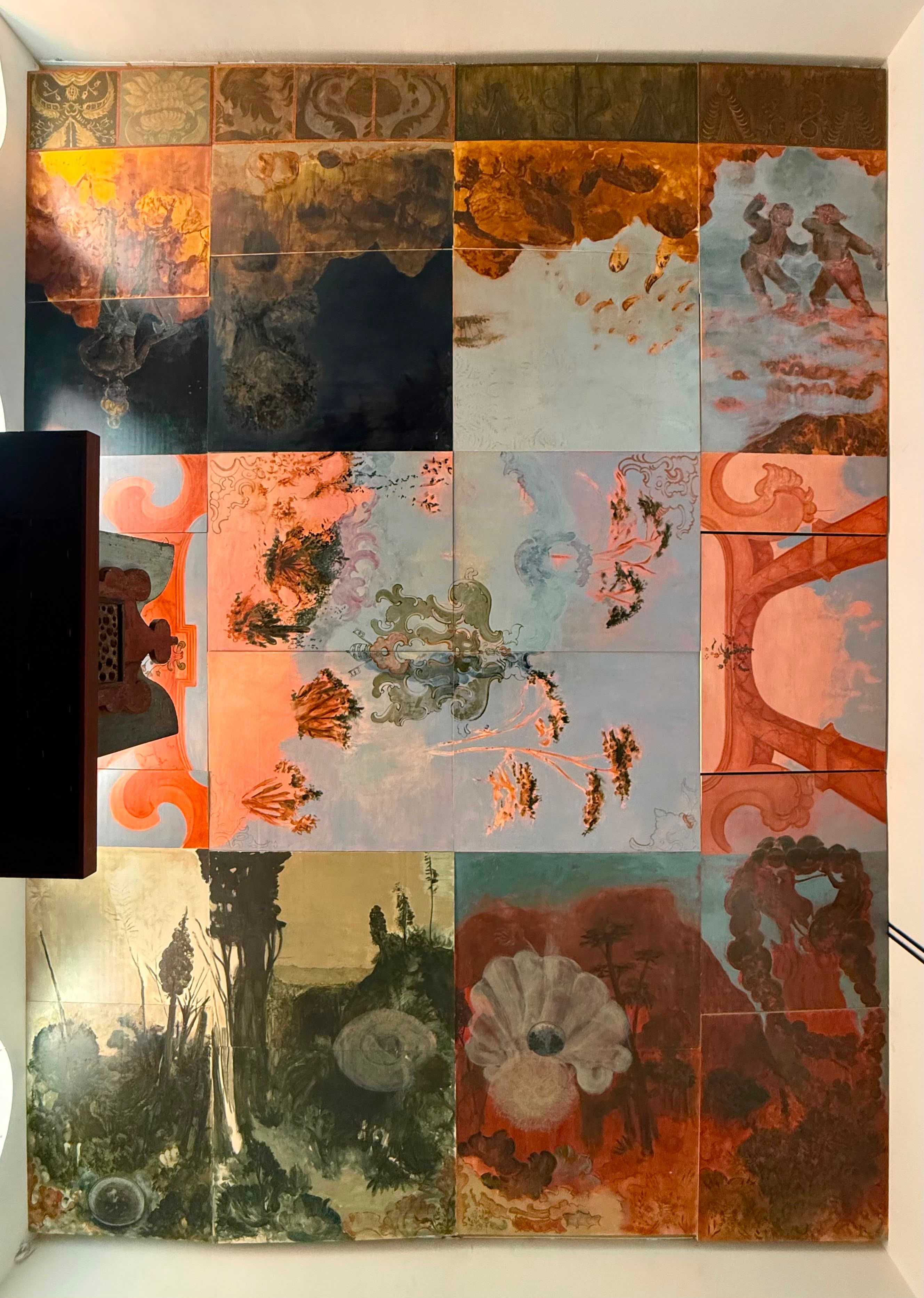
It is the chasm between metropolis and colony, but it is also the marvel of painting in making accessible what distance—whether spatial or metaphysical—seemed to prevent. That is why we need to view the ex-votos and the large canvases that make up this painted ceiling together. In truth, they are easel paintings arranged on the ceiling, much like the most interesting paintings from colonial Minas Gerais, where faux architecture never took hold. Unburdened by structural ambitions, the painted pilasters created by Ataíde’s workshop on the ceiling of the Church of São Francisco de Assis, just a few meters from here, are ethereal. They connect the building to a whimsical frame of rubble stone, yet they are unable to extend it all the way to where the sky opens up, where the glorification of the Holy Virgin takes place. Painting is nothing but distance: between its position and its construction, between the mundane and the divine, between its visual matrix and what results from it.
“Baroque,” it is worth remembering, is, in this context, an insufficient designation.
Distance may be the best way to interpret these paintings by David Almeida, in which the fascination with the past is resolved through the effort to make them respond to the present. Without being strict quotations, much less parodies, they seem to occupy an ambiguous zone where creation blends with the impulse to assimilate and translate—to translate into one’s own lexicon, to put them at the service of another interest, and not infrequently to betray them. They are paintings of approximation, made under the influence of distance. Between history and sensation, for example, lies the explicit mention of the Revolt of Filipe dos Santos, which reappears as an enigma; alongside Morro da Queimada, transformed into a visual suggestion, stands the figure of the prophet Elijah, taken up into the heavens in a chariot of fire, as in the painting in the nave mor of the Nossa Senhora Carmo church, in Sabará, . There is a distance between the characterizing type and the narrative opening, as in the evocation of Chico Rei, the legendary African king said to have lived in Vila Rica. An age-old risk: the rightful infidelity of
representation.It is also a matter of seeking the survival of this painting from the past, almost always anonymous and untouched by modern pressures of innovation.
Survival because, both in the paintings to which it refers and in the ex-votos presented together, one can still hear a whisper of painting: free and unhindered, even under the demands of decorum and convention, they remain magnetic. Hence the next step: to emancipate ornamentation, radicalize the palette, and confront the memory of the faux-silk borders with the discipline of modern painting—which amounts to freeing painting from inhibition. In short, to free everything from its initial castration, paving the way for ambiguities and pentimenti, thereby undoing the order inscribed by time.
One aspect is revealing in itself: by combining his now-familiar landscape fantasies with elements of colonial painting, the artist also invokes a certain chromatic tendency in Iberian painting—from José de Ribera (1591–1652) to Francisco de Goya (1746–1828)—that emphasized the gravity of rust tones and blacks. In fact, *Duelo a garrotazos*, one of Goya’s most disconcerting black paintings, is directly invoked: an archetypal image of futile struggle,
vague enough to embody the conflict between the Emboabas and the Paulistas. The painter is, rather, an “apprentice tourist, ” who, from Madrid to Ouro Preto, creates and recreates himself… By the way, one steals only from those one loves. And is there a better way to love than to put love to the test once again?
The objects on display constitute a chapter of their own. They are, in general, assemblages—composites that blend antique objects with additions and interventions. They almost always bear pictorial inscriptions that seek to transform the serendipity of the finish into a starting point. Far removed from the phantasmagoria entrenched by Farnese de Andrade in our tradition—and which perhaps finds its true equivalent only in the haunted novels of Cornélio Penna—these works constitute almost an antiquarian curiosity. They demand attention. They first seduced the artist, who now forces a future upon the things he has torn from the flow of time. But above all, they reiterate that direction Guignard mysteriously communicated to us: the insufficiency of any surface relegated to utility, an impoverished reality, as if each thing carried within itself a silent lack, awaiting the painting. A lack that even the most minimal pictorial element—painting at its most minimal—is capable of fulfilling.
In the best sense, these works by David are votive: they bear witness to the grace of seeing and being compelled to create, of discovering, in the worn- out world of the already seen, an opening to still paint.
____
1. Ouro Preto is a historic city in the state of Minas Gerais, Brazil, renowned for its exceptionally preserved colonial architecture and central role in the eighteenth-century gold cycle.
2. Ex-votos are votive paintings traditionally offered in gratitude for a miracle or divine intervention. In Brazil they were especially widespread between the eighteenth and nineteenth centuries.
Photography credits
Work photographs: Estúdio Em Obra
Installation views: Victor Galvão